Title
Content Creation with AI for 1st Phorm: Turning Committed Casey into a Content Strategy
This project connects a customer persona to keyword choices, blog ideas, a short article, LinkedIn copy, and an image concept. I used ChatGPT to develop the content, following the course workflow. This is an independent student marketing proposal, not an official 1st Phorm campaign.
Customer Persona
Information needed
What I will do and prompt: I will identify the inputs needed before asking AI to write marketing content. “I want to create a customer persona for 1st Phorm. What information do you need? Organize your answer into demographics, goals, purchase behavior, objections, media habits, and evidence needed. Distinguish customer data from website visitor data.”
What I did: I reviewed my earlier 1st Phorm customer persona and the company's About Us and Level-1 product page. My earlier project described an audience interested in fitness, consistency, community, and value. The current product page confirms that Level-1 is a protein powder offered through one-time and subscription purchase options. Those observations establish a product and buying context, but they do not establish the income, habits, or motivations of individual customers.
Result: The useful inputs are: age range and location; work and training schedules; fitness goals; reasons for choosing a brand; budget and purchase frequency; product questions; shipping and subscription concerns; preferred information sources; and the steps between discovery and purchase. First-party surveys, interviews, customer service themes, and purchase records would strengthen the persona. I did not reuse the earlier post's audience percentages as newly verified customer statistics. Website visitors and purchasers are different populations, and review counts do not establish repeat purchases.
Non-providable information:
What I will do and prompt: I will fill gaps with testable hypotheses rather than invented facts. “I do not have 1st Phorm customer interviews, transaction records, exact incomes, conversion data, or verified platform preferences. Suggest plausible working assumptions for an adult recreational lifter with a busy job. Label each as a hypothesis, explain its marketing implication, and propose a way to validate it. Do not invent statistics.”
Result:
| Missing information | Working hypothesis | Marketing implication and validation |
|---|---|---|
| Daily schedule | Work competes with training and meal planning. | Test practical planning content; ask customers when routines break down. |
| Spending priorities | Casey compares usefulness and cost per serving. | Explain value transparently; interview buyers and nonbuyers about objections. |
| Information preferences | Casey wants concise explanations before detailed product research. | Test a short checklist against a longer comparison and measure engaged visits. |
| Subscription concerns | Casey wants control over recurring purchases. | Link clearly to current terms; review support questions and abandonment feedback. |
| Community motivation | Accountability may matter alongside product features. | Test community-oriented messaging against convenience messaging. |
These assumptions guide an initial experiment. They are not findings about all 1st Phorm customers.
Generating customer persona
What I will do and prompt: “Using the verified product context and labeled hypotheses above, refine Committed Casey for 1st Phorm. Include background, goals, barriers, buying questions, content preferences, a fictional quote, and a marketing recommendation. Make clear that Casey is a composite persona, not a real customer or a statistically validated segment.”
Result: Committed Casey is a fictional 28-year-old working adult in the Midwest who tries to fit regular strength training around a demanding schedule. Age, location, occupation context, and habits are illustrative assumptions. Casey wants a repeatable routine, understandable product information, and a fitness community that supports consistency. The main barriers are time, confusing choices, and concern about paying for something that goes unused. Before buying, Casey asks: What problem does this solve? What does each serving cost? What ingredients and allergens should I check? What happens if my schedule changes? A fictional quote captures the need: “Give me a plan I can repeat when work gets busy.”
Actionable insight: Lead with a practical routine checklist, then offer relevant product information. Test that approach against product-first copy. Measure qualified product-page visits and useful engagement rather than assuming more impressions mean more customers.
Search engine optimization (SEO)
Keyword research
What I will do and prompt: “Suggest exactly five Google keyword phrases relevant to 1st Phorm and Committed Casey. Mix branded research with practical informational intent. For each, explain the intent and content opportunity. Do not claim these are the most searched keywords or invent search volume, competition scores, or rankings.”
Result:
| Keyword | Search intent | Content opportunity |
|---|---|---|
| 1st Phorm protein powder | Commercial research | Explain where to find product details and compare options. |
| 1st Phorm Level-1 | Branded product research | Answer label, serving, and purchase-option questions. |
| protein routine for busy professionals | Informational | Create the selected routine-planning article. |
| how to compare protein powder cost per serving | Informational/commercial | Offer a transparent comparison checklist. |
| how to stay consistent with fitness | Informational | Share a simple planning and accountability framework. |
These are AI-generated keyword candidates, not measured demand. Before prioritizing them for a real campaign, I would check Google Keyword Planner for demand estimates, review the search results for intent, and use Search Console to see which relevant queries already bring visitors to this site. I would use one primary phrase naturally in the title and opening, add descriptive links, and avoid repeating all five phrases in every paragraph.
Content creation
Blog post idea.
What I will do and prompt: “Using Committed Casey and the five proposed keywords, create exactly three useful blog ideas for an independent marketing portfolio about 1st Phorm. Explain the reader's problem, primary keyword, and next step. Avoid unsupported health claims and pretend product experiences.”
Result:
1. A Protein Routine for Busy Professionals: Keep It Simple with 1st Phorm in Mind. Problem: planning falls apart during busy weeks. Primary keyword: protein routine for busy professionals. Next step: write a simple weekly checklist.
2. How to Compare Protein Powder Cost per Serving Before You Buy. Problem: package prices make value hard to compare. Primary keyword: how to compare protein powder cost per serving. Next step: compare current labels and total purchase costs.
3. Considering 1st Phorm Level-1? Questions to Ask Before Your First Order. Problem: shoppers need clear product and purchase information. Primary keyword: 1st Phorm Level-1. Next step: review the official product details and current subscription terms.
I selected the first idea because it starts with Casey's practical problem and gives the brand a relevant supporting role. The other two ideas could become internal links in a future content series.
Writing a blog post.
What I will do and prompt: “Act as an independent fitness-content blogger writing for Committed Casey. Write a 500-word article titled ‘A Protein Routine for Busy Professionals: Keep It Simple with 1st Phorm in Mind.’ Use an approachable tone, active voice, and singular first person when needed. Include a clear next step at the end of each section. Use the primary keyword naturally. Do not claim personal product use, guaranteed results, medical benefits, or verified customer preferences. Mention Level-1 only as an option to research. Count the article body, excluding its title.”
Result — 500-word article (including section headings, excluding title):
A Protein Routine for Busy Professionals: Keep It Simple with 1st Phorm in Mind
Busy weeks expose complicated plans. A meeting runs late, your gym bag stays in the car, and the dinner you planned becomes whatever looks easiest. I would build a protein routine for busy professionals around fewer decisions. The goal is a routine you can repeat, with products playing a supporting role. Start by identifying the moment when your current plan usually breaks down.
Start with your real schedule
Look at the week you have. Mark early starts, travel days, and evenings when cooking feels unrealistic. Then identify meals you enjoy and can prepare. You do not need a spreadsheet to notice the same afternoon scramble happening repeatedly. A note on your phone can reveal the pattern. Choose one busy day and write down tomorrow's meal plan tonight.
Make convenience practical
Keep your plan easy to carry out. That might mean packing lunch before bed, keeping your shopping list consistent, or placing your shaker beside your work bag. If you consider a protein powder, decide what specific convenience problem it would solve. A purchase without a clear role can become another unused item in the cupboard. Pick one preparation step that takes less than five minutes and attach it to something you already do.
Research before buying
1st Phorm offers Level-1 protein powder, but a familiar name should start your research, not finish it. Review the product page, the label for your flavor, ingredients, allergens, and serving information. Compare the details with your preferences and needs. I would also check the total order cost rather than focusing on the headline price. Open the official product page and record the questions you still need answered.
Compare the purchase options
A subscription only makes sense when its timing matches your use. Before choosing recurring delivery, review the terms and the steps for changing, skipping, or canceling an order. Compare the cost per serving across the options you are considering, using the same calculation each time. Avoid assuming that a larger order automatically creates better value. Write down your expected usage and compare it with the proposed delivery schedule.
Build accountability into the week
Consistency can feel easier when someone knows what you are trying to do. A friend, training partner, or community can provide a check-in without turning every meal into a performance. Keep the conversation practical: what worked, what felt inconvenient, and what needs to change? The useful question is whether your plan fits your life. Schedule one weekly check-in with someone who supports your goals.
Review and simplify
At the end of the week, keep the parts you repeated and revise the parts you avoided. You might need a shorter shopping list, an earlier reminder, or a different packing routine. I would judge the plan by how usable it feels during a workweek. Small adjustments can make the next week easier to organize. Create a three-item checklist today: plan one meal, prepare one item, and review one product question. Put that checklist somewhere you will see it before tomorrow gets busy.
Marketing insight: The article answers an informational need before asking for a purchase. Its calls to action progress from planning to product research, which suits a reader who may not be ready to buy. I would test the title and opening, then assess engaged visits and clicks to relevant product information. I would not treat a click as proof of a sale.
Social media post
What I will do and prompt: “Create a LinkedIn post about the selected article for Committed Casey, a busy working adult. Open with a workday problem, summarize three practical takeaways, invite discussion, and direct readers to the article in this portfolio. Keep the tone professional and approachable. Use LinkedIn rather than Instagram. Do not imply endorsement by 1st Phorm.”
Result:
A busy calendar can turn a simple fitness routine into another unfinished task.
For my latest digital marketing project, I created a practical article for working adults exploring 1st Phorm: “A Protein Routine for Busy Professionals: Keep It Simple with 1st Phorm in Mind.”
The three takeaways:
• Plan around the workweek you actually have.
• Give every product a clear purpose before buying it.
• Compare serving costs and delivery terms before choosing a subscription.
My marketing takeaway: useful content should answer the customer's next question. For the fictional persona Committed Casey, that question is how to make a routine easier to repeat.
Read the 500-word article in this portfolio post. What small habit helps you stay consistent when work gets busy?
#ContentMarketing #DigitalMarketing #CustomerExperience
Actionable insight: LinkedIn makes the workday angle relevant. I would compare a routine-focused opening with a product-research opening and track meaningful comments and article visits. This is proposed LinkedIn copy; it has not been posted to LinkedIn.
Image creation
What I will do and prompt on ChatGPT: I will translate the assignment's brand-value statement into a visual concept. “I am going to draw a picture regarding the text below using an AI image generator. Write a proper prompt: 1st Phorm constantly strives to develop new products and works hard to provide the best value to its customers. Additionally, it always does its utmost to serve the community. Treat this as a proposed campaign theme, not evidence of a specific event. Create an inclusive, credible scene without fabricated product claims.”
What I will do and prompt on Leonardo.AI: The prompt below is ready to paste into Leonardo.AI. The selected image was generated with ChatGPT's image-generation tool, one of the assignment's allowed tools; I did not run a separate Leonardo.AI generation.
Image prompt: “Create a polished editorial campaign concept illustration for a student digital marketing portfolio about 1st Phorm. Landscape 3:2 composition. Show an inclusive group of adult recreational athletes and a sports nutrition product designer around a table in a bright modern community gym, discussing a simple unbranded shaker and unbranded prototype nutrition containers, a notebook with abstract unreadable sketch lines. In the background other adult volunteers arrange plain boxes for a community wellness event. Emphasize thoughtful product development, practical customer value, and community service. Realistic editorial photography aesthetic, natural daylight, blue, black, and neutral palette, candid collaborative gestures, realistic varied bodies, no exaggerated physiques, no readable text, no logos, no watermark. This is a fictional campaign concept, not documentation of an actual company event.”
Result: I selected this image because it connects product discussion with community participation.
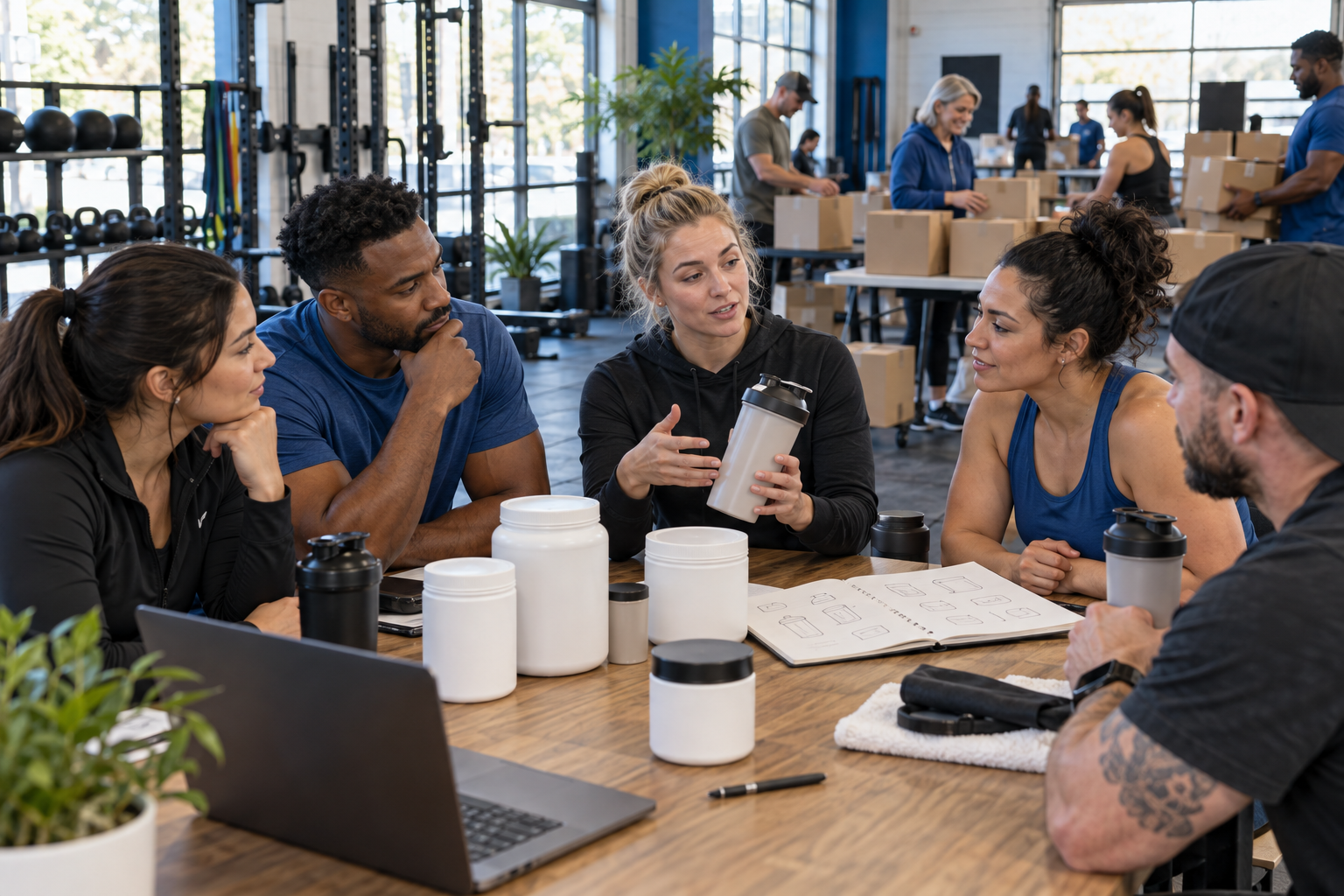
Suggested alt text: Adults collaborate around prototype nutrition containers in a community gym while volunteers prepare an event in the background.
Marketing insight: The image supports the community and practical-value themes without pretending to show real employees or a documented charitable activity. I would test this community concept against a simpler product-information visual and evaluate article engagement.
Process reference: Digital Marketing Research Lab's ChatGPT workflow. Company pages reviewed October 13, 2026. All persona gaps, keyword demand, and campaign performance remain hypotheses until validated.