For this project I had to pick companies I would actually want to work for, and 1st Phorm was the easy first choice. I have been training seriously for years and I work in direct sales, so a supplement company that built its whole business on a sales culture is about as close to my world as it gets. This post breaks down who their customer actually is, based on research rather than what I assumed going in.
Why 1st Phorm
1st Phorm is a direct-to-consumer sports nutrition brand based in Fenton, Missouri, just outside St. Louis. Andy Frisella and Chris Klein opened their first Supplement Superstore on January 1, 2000 and did seven dollars in sales on day one. They launched 1st Phorm as their own manufactured brand in 2009. Today their headquarters is a 185,590 square foot building with an NBA-regulation basketball court, a podcast studio, and a retail store open to the public.
They meet both requirements for this assignment. Their LinkedIn company page is active at linkedin.com/company/1st-phorm-international, and their Fenton headquarters is a public retail location with a Google Business Profile. Their Supplement Superstore retail network carries 42 locations across Missouri, Illinois, Kansas, Oklahoma and Indiana, all with Google listings.
The Persona: Committed Casey
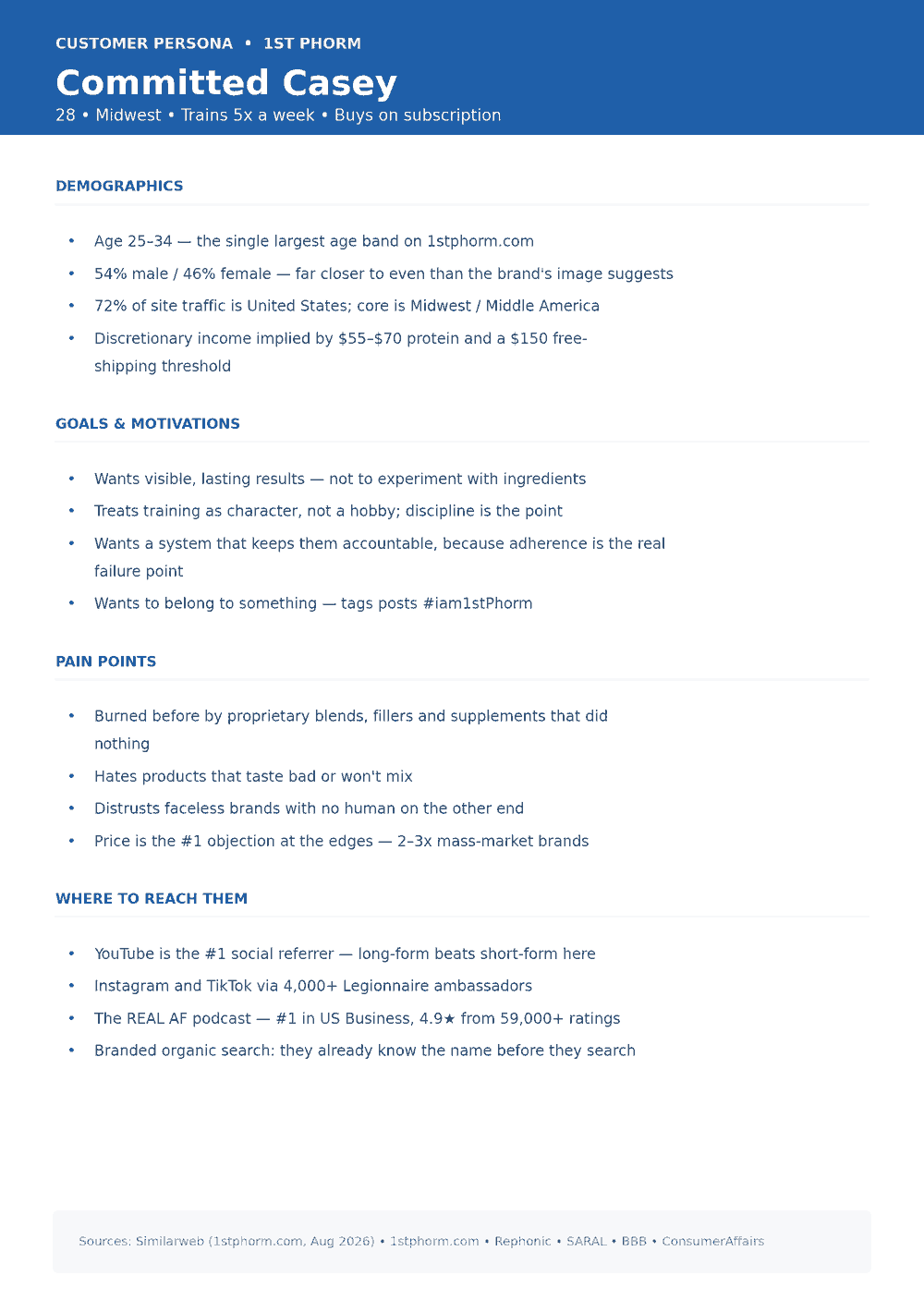
Here is the persona I built from the research. I named her Casey on purpose, and I will explain why in a second.
The thing that surprised me most
I assumed 1st Phorm’s audience would be overwhelmingly male. It is not. Similarweb’s audience data for 1stphorm.com shows a split of 54.19% male and 45.81% female. That is close to even, and it is a much higher share of women than I expected from a brand that markets itself with so much hard-nosed, never-settle language.
That single number changes how you would market to them. If you built a campaign around the assumption that this is a bro brand, you would be talking past almost half the audience. It is also why I gave the persona a name that works either way instead of defaulting to a guy.
The largest age group is 25 to 34, and 71.95% of site traffic comes from the United States. Combined with the physical retail footprint concentrated in the Midwest, the core customer is Middle America, not the coasts.
What they actually care about
The more I read, the more obvious it became that 1st Phorm is not really selling supplements. It is selling membership. Customers tag their own posts with #iam1stPhorm. The ambassador program is called the Legion. The About Us page frames the buyer as someone who refuses to settle.
There is also a discipline angle that goes well beyond fitness. Andy Frisella created 75 Hard, a free mental toughness program, and his REAL AF podcast is ranked number one in US Business and Entrepreneurship on Apple Podcasts with 4.9 stars from over 59,000 ratings. A podcast that ranks in business, not fitness, tells you the audience overlaps heavily with self-improvement and entrepreneurship. These are people who see training as character building.
How big the repeat base really is
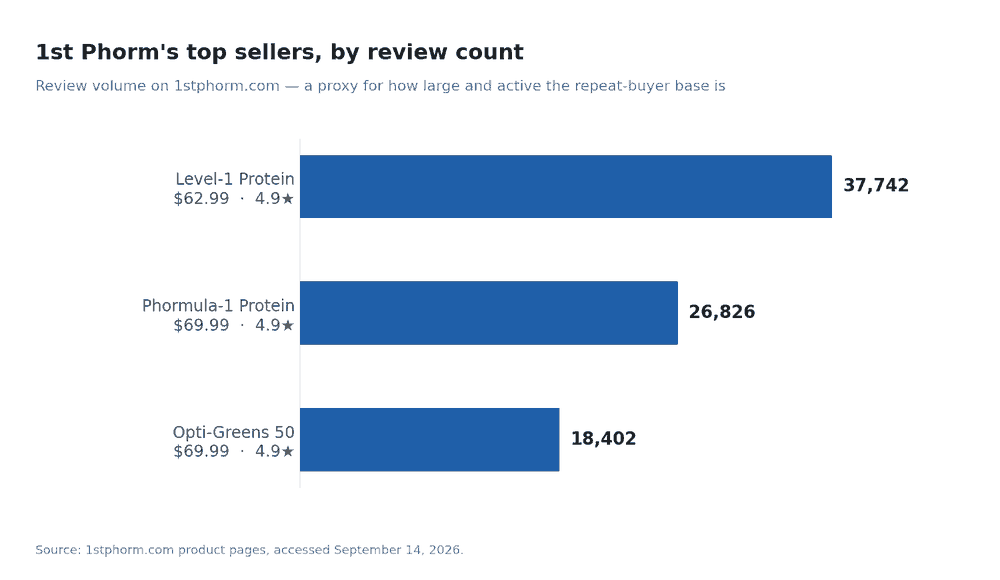
Those review counts are on 1st Phorm’s own site, and they say something important about loyalty. A single protein powder with almost 38,000 reviews is not a product people try once. Every major product also has a Subscribe and Save price roughly eight to ten dollars below the one-time price, and the affiliate program uses a lifetime cookie, meaning a customer stays credited to the ambassador who referred them forever. The entire business is built around repeat purchase.
What customers complain about
This is where it gets interesting. On 1st Phorm’s own site, reviews sit at 4.9 stars across tens of thousands of ratings. On third-party sites, the picture flips. Trustpilot has them at 2.8 stars from 18 reviews. The Better Business Bureau shows 3.23 stars from 13 reviews, even though the company itself holds an A+ BBB rating.
The negative reviews cluster around three things: shipping delays, problems getting the 110% money back guarantee honored, and price. One BBB reviewer wrote, “Do not buy or trust them! 110% back guarantee and charge you for return shipping.” Another customer on Trustpilot said the company could not locate her orders at all.
What stands out is that the guarantee is their signature promise, so when it fails, it makes people angrier than a bad product would. The flip side is that customer service is also the single most praised thing in positive reviews. One customer wrote, “I’ve never gotten such personable service from some of the other big brands.” Service is both their biggest loyalty driver and their biggest risk.
Where I would reach this customer
YouTube is 1st Phorm’s top social referrer, ahead of Instagram and Facebook. That is unusual for a supplement brand and it fits their long-form podcast strategy. Organic search brings in 34.09% of traffic, but the top keywords are branded, meaning people already know the name before they search. Discovery is happening somewhere else, mostly through the 4,000-plus Legionnaire ambassadors who earn up to 25% commission.
If I were running marketing here, I would not chase new awareness channels. I would fix the shipping and returns experience, because that is the one thing actively costing them the trust everything else is built on.
Sources
- Similarweb, audience and traffic data for 1stphorm.com, accessed September 14, 2026
- 1stphorm.com, product pages and About Us, accessed September 14, 2026
- 1stphorm.com/pages/legionnaire, ambassador program terms
- Better Business Bureau, 1st Phorm customer reviews and business profile
- Trustpilot, reviews for 1stphorm.com
- ConsumerAffairs, 1st Phorm customer reviews
- Rephonic, audience statistics for the REAL AF podcast
- SARAL, analysis of 1st Phorm’s influencer and ambassador program
- KSDK and St. Louis Business Journal, reporting on the Fenton headquarters
- Patch, reporting on the founding of Supplement Superstore
1 thought on “Who Actually Buys 1st Phorm? Building a Customer Persona from Real Data”